StyrOps CPS Lab

Self-reasoning
cyber-physical systems

Machines that carry their own reasoning, improve themselves like scientists, and are born in simulation. A research lab at Luleå University of Technology, built on the open ColonyOS substrate.

Research vision

The LLM becomes a first-class component of cyber-physical system design.

Local reasoning

A reasoning engine in every machine

Local LLMs on limited hardware, at the asset: offline, sovereign, low-latency. Talk to any device in plain language; the machine reasons over its own sensors, logs, and self-model.

Self-improvement

Improvement as empirical engineering

Self-improvement is not blind patching. Agents form hypotheses, run controlled experiments, evaluate versioned oracles, and pass guards — every step an immutable, replayable process chain.

Digital twins

Born and verified in simulation

Agents generate digital twins of the systems they will run, develop and verify against the twin, and keep it in the loop as a guardrail oracle once deployed.

Research challenges

Agentic AI on real assets is not a solved engineering problem. The open questions are not about model size — they are about what it takes for an answer to be acted on.

Deployment gap

Benchmarks are not plants

Agents that ace benchmarks still fail on real assets. Live systems bring messy signals, missing context and consequences that no leaderboard measures.

Trust

The question is not “can it answer?”

On a safety-critical system the question is whether the answer can be trusted — and what evidence is on record when it is followed.

Architecture

Hallucination is unavoidable

Trustworthiness therefore comes from architecture, not from a better prompt: grounding, guardrails, abstention, and auditable evidence.

The lab

A physical lab at Luleå University of Technology, running the compute continuum in three always-on tiers.

Far edge
Reasoning at the asset Handheld Raspberry Pi 5 devices, sensor probes, inspection cameras and mobile robots, running 1–7B quantized models directly on the machine.
Edge inference
Frontier models on site On-prem GPU servers with 192 GB of GPU memory each, running frontier reasoning models locally. Data never leaves the site.
Cloud · HPC
Burst capacity on demand Overflow to cloud and HPC when a job outgrows the site, and only then.

ColonyOS places each workload at the right tier.

Example applications

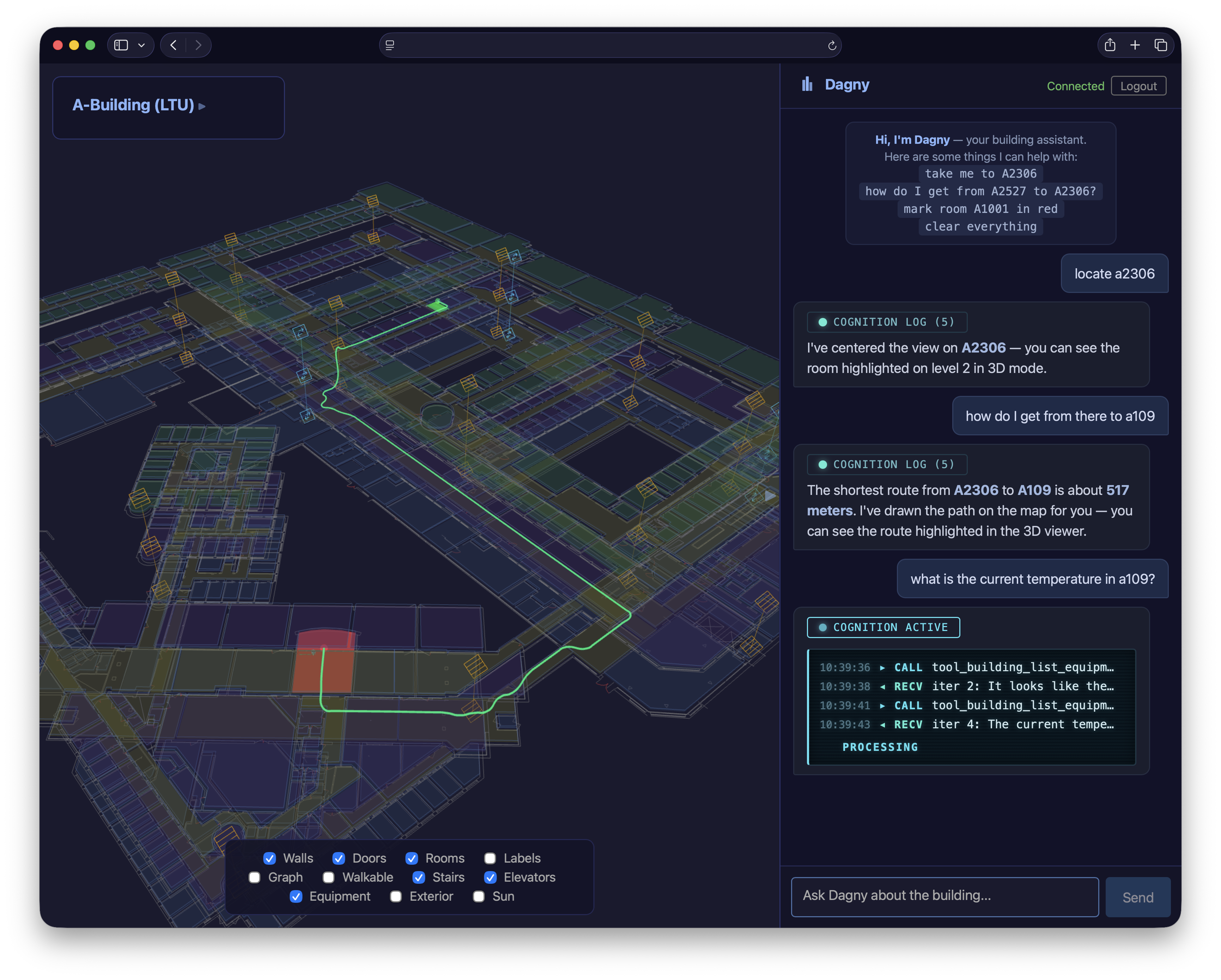
Dagny building assistant
Smart buildings

Building intelligence

3D building twin the agent navigates, queries, and acts on in the loop.

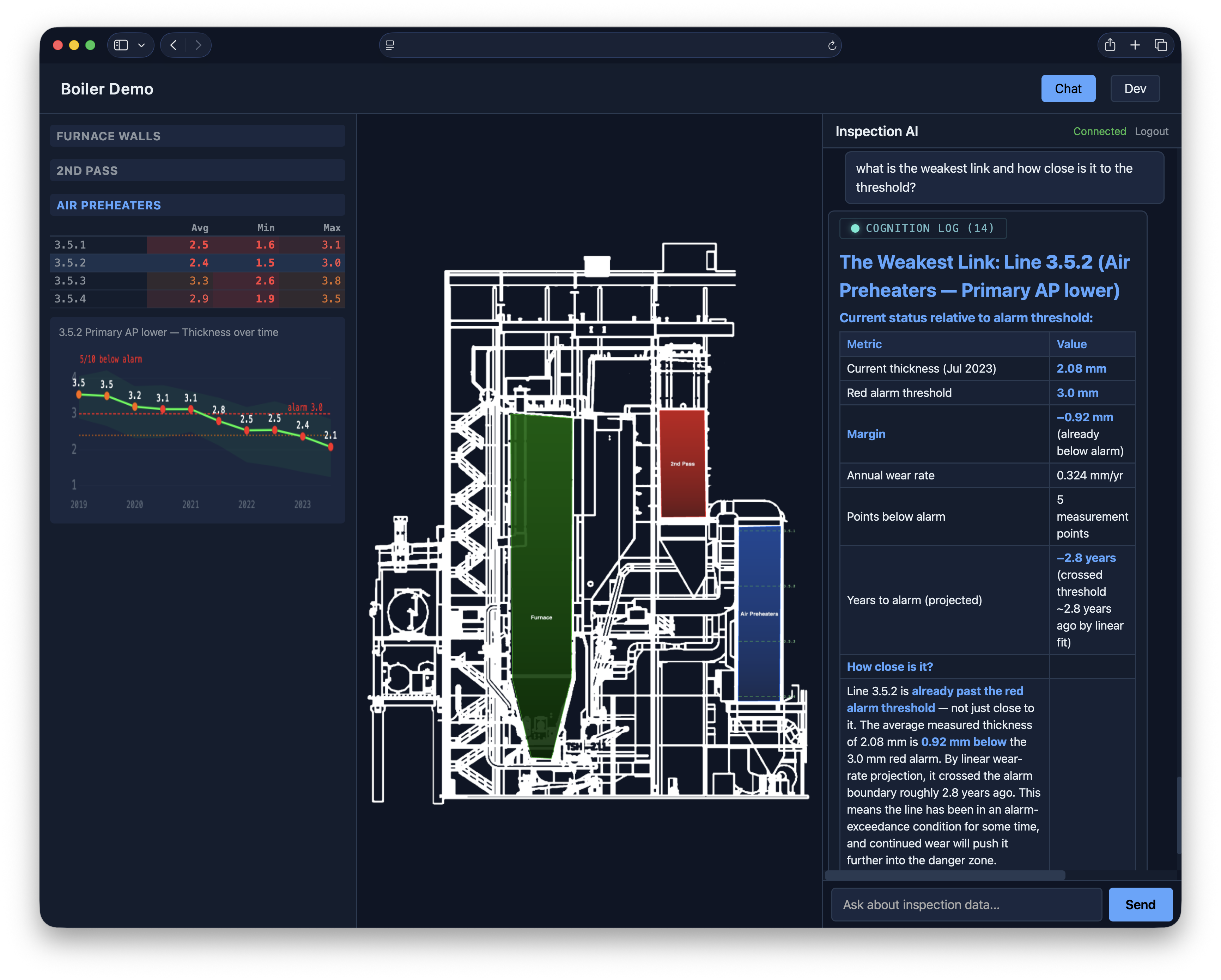
Boiler inspection AI
Boiler Inspection AI

Wall thickness analysis

Inspection workflows over ultrasonic measurement data, with auditable reports.

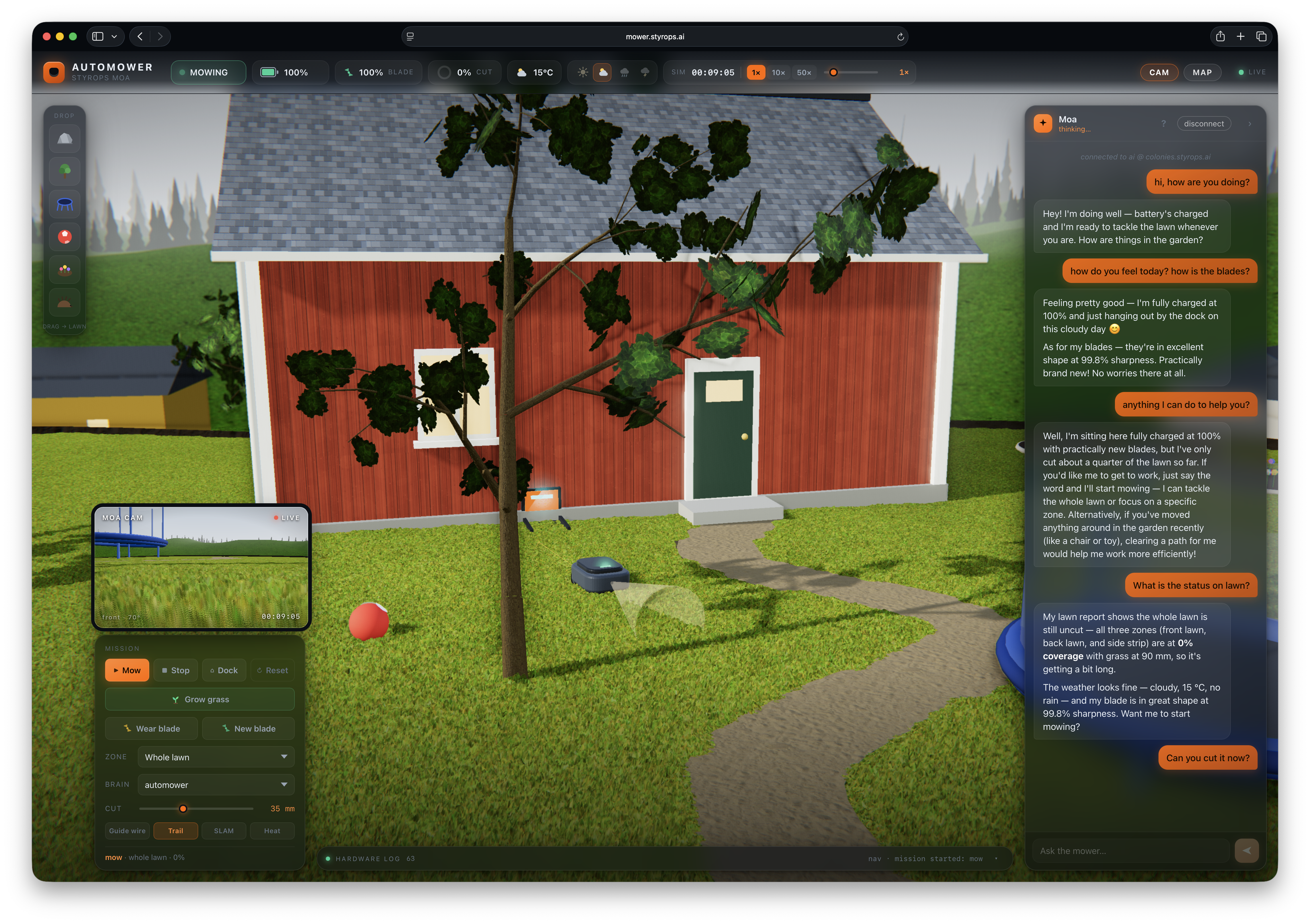
Autonomous mower with onboard AI
Autonomous robots

Robot mower with onboard AI

A robot you talk to: the agent runs mowing missions, reads its own hardware logs, and explains itself. This demo — simulator, robot and UI — was generated and verified by AI agents in two days.

PhD projects

Three research directions, one question: what does it take to trust autonomous systems in the physical world?

Autonomy

Safe autonomy over live systems

When can an AI agent be allowed to act — and when must it hold back? Architectures where language models diagnose and decide while grounding, guardrails, and digital twins supply the restraint, so autonomy earns trust instead of assuming it.

Selected result5/5 correct abstention on honest load, zero false actions

Continuum

The self-aware continuum

Orchestration across IoT, edge, and cloud where the application tells the infrastructure what matters right now. Scheduling, scaling, and offloading driven by runtime relevance instead of static thresholds — less cloud, better service, at industrial scale.

Selected result−24% cloud hours on production mining workloads

Distributed trust

Trust without connectivity

Multi-stakeholder cyber-physical systems that keep operating through disconnection and still converge on one auditable truth: who was allowed to do what, when, and on whose authority. Decentralized authorization, tamper-evident history, deterministic reconciliation.

Selected resultDeterministic deny-wins replay, verified in Rust

Teaching

D7065E — Embedded Intelligence at the Edge (7.5 ECTS, Luleå University of Technology). Course notes, hands-on tutorials, labs, and a building-simulation server, all open: github.com/eislab-cps/D7065E.

Work with the lab

Direct

Commissioned research

Your problem, our researchers. Industrial PhD option, publishable results.

Co-funded

EU / Vinnova projects

Co-funded innovation at scale, with consortium partners across Europe.

Membership

CPS Lab partnership

Shared infrastructure, joint pilots, and a seat in the centre.

Short horizon

Innovation / MVP track

From idea to working prototype on a short horizon, via LTU Business.

Bring a real problem to the lab. Get in touch